For newly expectant or practicing parents, learning that their baby has hearing loss will feel overwhelming and disheartening. However, the encouraging reality remains: through prompt screening and early care, infants with auditory challenges routinely attain great success. In fact, such infants can build spoken language, expressiveness, and meaningful bonds throughout their community, ensuring a bright, enriched future!
Deploying personal hearing aids or medical cochlear devices provides two highly reliable options for helping infants with auditory challenges. Within this detailed breakdown, we assess their basic functions and explain how to choose the proper device for your child.
Unpacking the Foundations of Infant Hearing Loss
Auditory loss among newborns typically originates from several potential sources, including:
- Genetic factors (even when lacking a documented family history)
- Maternal pathogen exposures including cytomegalovirus (CMV) and rubella viruses
- Birth-related trauma, featuring neonate oxygen loss or premature delivery
- Particular ototoxic pharmaceuticals administered in specialized neonatal units
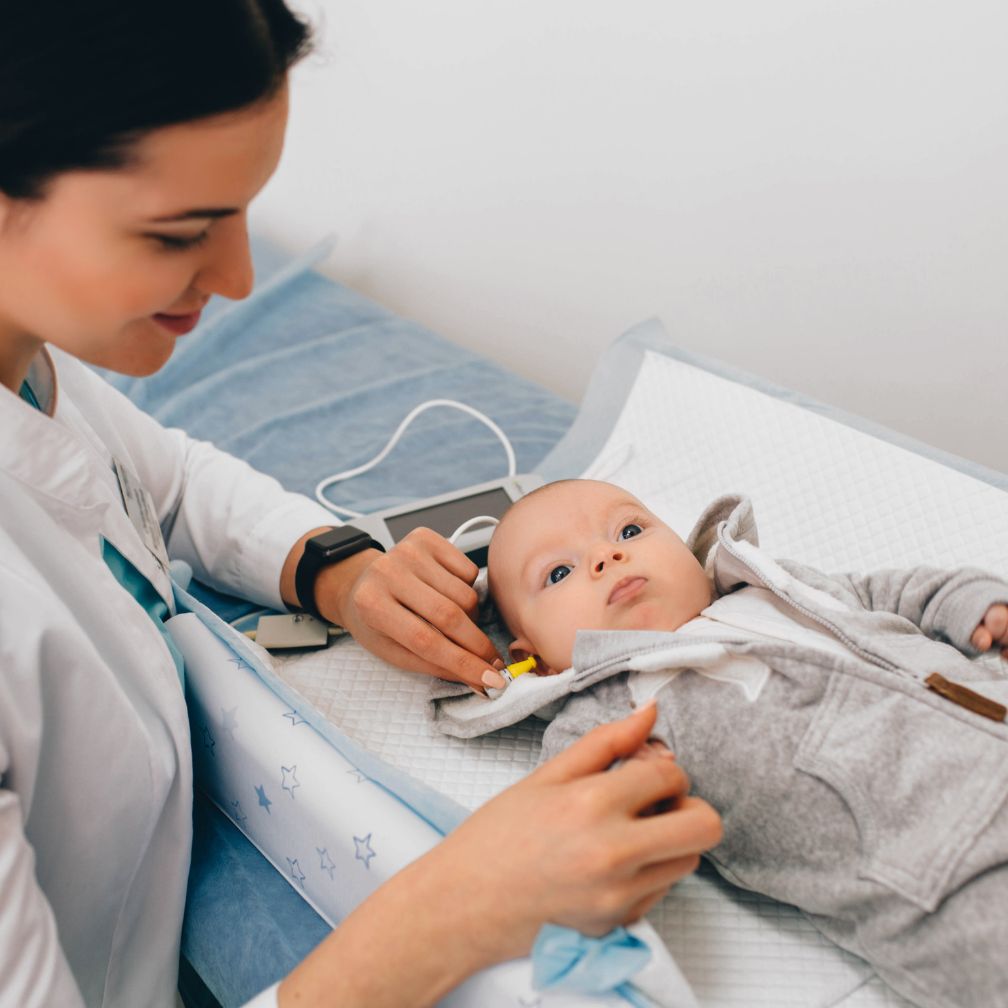
What serves as the chief goal for families? Early diagnostic testing. Because of this, newborns across American healthcare facilities undergo hearing evaluations before heading home. Board-certified pediatric audiologists strictly uphold the standardized “1-3-6” care benchmark:
- Primary baseline screening executed inside 30 days post-birth
- Comprehensive diagnosis finalized prior to 3 months of age
- Early intervention (utilizing amplification devices or targeted therapy) launched prior to 6 months of life
Attaining these developmental checkpoints provides infants an optimal path toward speech acquisition, language mastery, and cognitive growth. In the event you want clarification regarding these testing procedures, your personal pediatrician stands eager to help!
Understanding Amplification Devices for Infants
When addressing infants with mild to severe auditory impairment, digital hearing aids routinely constitute the preferred initial approach. Such compact, fitted instruments increase acoustic volume, enabling babies to process spoken dialogue and surrounding noise with greater accuracy.
Custom infant-adapted hearing aids act as:
- Dermatologically and structurally safe for infants aged just a few weeks
- Manufactured with soft, flexible ear impressions that adjust seamlessly as the baby grows
- Equipped with tamper-resistant battery latches and specialized pediatric safety components
- Uniquely adjusted by a specialized pediatric audiologist to fit your infant’s precise diagnostic profile
During physical development, hearing aids necessitate regular clinical recalibrations to preserve physical fit and functional efficacy.
Cochlear Implants in Infant Auditory Care
Should an infant suffer from severe to profound sensorineural impairment while getting minimal improvement from hearing aids, care teams frequently advise a cochlear implant. Differing fundamentally from traditional hearing devices, cochlear implants:
- Require precision surgical implantation directly into the auditory system
- Bypass damaged parts within the auditory system
- Convert sound into electrical signals that activate the hearing nerve directly
Specialized pediatric cochlear implants act as:
- Fully approved by the FDA for infants as young as 9 to 12 months
- Highly successful when paired with early auditory-verbal therapy and consistent family engagement
- Recommended only after a complete clinical review by an audiologist and ENT specialist
This diagnostic phase features radiological imaging, detailed hearing tests, and setting realistic expectations for future communicative success.
Comparing Hearing Aids and Cochlear Implants: Key Differences
- Mild to severe hearing loss targets Hearing Aids; Severe to profound hearing loss necessitates Cochlear Implants
- Non-Invasive wearable application: Hearing Aids; Surgical internal implantation: Cochlear Implants
- Traditional acoustic amplification: Hearing Aids; Converts Sound Electrical Signals: Cochlear Implants
- Application starts during early infancy: Hearing Aids; Placement starts at 9-12 months: Cochlear Implants
Final Conclusions: Selecting the Right Path for Your Infant
In the event your infant receives a hearing loss diagnosis, rest assured that clear options and robust community resources exist to help you. Thanks to collaboration with dedicated pediatric audiologists, many young children achieve language capabilities completely equal to their hearing peers.
Irrespective of whether your child receives fitting for hearing aids or surgery for cochlear devices, acting swiftly creates a profound lifelong advantage.
Are you looking for clarity regarding your infant’s hearing development? Call our clinic today to schedule a thorough assessment and individualized management strategy.